




 How can I assist you?
Electric Bike vs Petrol Bike Cost Comparison: Breaking Down the Numbers
Initial Purchase Price: What You Pay Upfront
Most commuter electric bikes in India are priced between ₹90,000 and ₹1,40,000, while comparable petrol bikes range from ₹80,000 to ₹1,20,000. The headline price difference can appear significant, but government subsidies and tax benefits close this gap considerably. Under the PM E-DRIVE scheme – which came into effect on October 1, 2024, following the conclusion of FAME-II in March 2024 and the transitional EMPS 2024 scheme that bridged the gap from April to September 2024 – electric two-wheelers continue to receive demand incentives that reduce the effective purchase cost. When zero road tax and lower registration fees across most states are factored in, the real on-road difference between an electric and petrol bike narrows to approximately ₹10,000 to ₹15,000.
Running Cost Analysis: The Kilometre-by-Kilometre Difference
This is where electric bikes deliver their most decisive advantage. Charging a mid-range electric bike at home costs approximately ₹0.28 to ₹0.40 per kilometre.Based on current residential electricity tariffs of ₹6 to ₹9 per unit. A full charge typically costs ₹30 to ₹40. By contrast, petrol bikes with a mileage of 45 to 50 km per litre cost ₹2.10 to ₹2.50 per kilometre at today’s prevailing fuel prices. For a rider covering 10,000 km per year, annual electricity charges total approximately ₹2,800 to ₹4,000 versus ₹18,800 to ₹23,000 in petrol expenditure, a gap that translates into meaningful savings every single month.
Maintenance Expenses: Annual Service Costs Compared
Electric bikes require ₹1,500 to ₹2,500 yearly for basic upkeep, covering tyres, brakes, and routine inspections. There is no engine oil, no spark plug replacement, no clutch servicing, and no gearbox maintenance. Petrol bikes, by contrast, demand ₹5,000 to ₹8,000 annually owing to oil changes, air filters, fuel system checks, and engine tune-ups. Over five years, maintenance savings alone with an electric bike can reach ₹25,000 to ₹30,000.
Battery Replacement vs Engine Overhaul: Long-Term Costs
Battery replacement remains the most significant long-term cost consideration for electric bike buyers. Modern lithium-ion and lithium iron phosphate (LFP) batteries are rated for approximately 1,200 full charge cycles, covering 1,50,000 to 1,80,000 km before replacement is needed. In practice, most riders will require a battery replacement after six to eight years of use. Current market prices for battery replacement in India range from ₹50,000 to ₹60,000, which when amortised across the ownership period represents a manageable per-kilometre addition. Petrol engines, meanwhile, require cumulative maintenance and periodic overhauls that often exceed battery replacement costs when calculated over the same timeframe.
5-Year Total Cost of Ownership
When all factors are combined, including purchase price, fuel or electricity costs, maintenance, and battery amortisation, electric bikes offer a clear financial advantage over five years. The exact figures vary by model, city, and riding frequency, but the directional savings of ₹70,000 to ₹1,00,000 over five years hold across most scenarios for daily commuters covering 8,000 to 12,000 km annually.
| Cost Factor | Electric Bike | Petrol Bike |
|---|---|---|
| Initial Purchase Price | ₹90,000 – ₹1,40,000 | ₹80,000 – ₹1,20,000 |
| Net On-Road Difference | ₹10,000–15,000 higher (after subsidies and tax benefits) | Baseline |
| Running Cost Per Kilometre | ₹0.28 – ₹0.40 | ₹2.10 – ₹2.50 |
| Annual Running Cost (10,000 km) | ~₹2,800 – ₹4,000 | ~₹18,800 – ₹23,000 |
| Annual Maintenance Cost | ₹1,500 – ₹2,500 | ₹5,000 – ₹8,000 |
| 5-Year Maintenance Savings | ₹25,000 – ₹30,000 lower | Baseline |
| Battery Replacement (6–8 years) | ₹50,000 – ₹60,000 | Higher cumulative engine costs |
| Battery Lifespan | 1,200 cycles (1,50,000–1,80,000 km) | N/A |
| 5-Year Total Savings (estimate) | ₹70,000 – ₹1,00,000 | Baseline |
| Road Tax | Complete or partial exemption | 4–15% of ex-showroom price |
| Ready to Finance Your Electric Bike? Credit Wise Capital offers quick and transparent two-wheeler loan approvals so you can make the switch to electric without delay. Click the banner on our website or apply directly online today. Apply for a Two-Wheeler Loan at Credit Wise Capital |
Performance Comparison: Speed, Acceleration and Real-World Riding
Acceleration and Torque Delivery
Electric motors deliver their full torque the instant you open the throttle, with no need for the engine to build revs. This immediate response means electric bikes consistently outperform petrol commuters in stop-and-go traffic. Performance models such as the Revolt RV400 generate 180 Nm of wheel torque, while the Oben Rorr achieves 0 to 40 kmph in just 3 seconds. Most commuter electric bikes reach 0 to 40 kmph in 3 to 5.2 seconds, compared to 4 to 6 seconds for comparable petrol bikes.
Top Speed Capabilities
The majority of commuter electric bikes are governed to 70 to 85 kmph, which is adequate for urban riding. Performance-oriented models such as the Ultraviolette F77 achieve 155 kmph, placing them firmly in the sports bike segment. Petrol bikes maintain an advantage at the top end of the speed range and in sustained highway cruising, where fuel energy density allows higher continuous speeds.
City Traffic Performance
Zero clutch operation and instant torque make city riding noticeably smoother on an electric bike. Lane changes and quick overtakes require minimal effort. Petrol bikes demand constant gear shifting in congested conditions, adding rider fatigue over long commutes. For the majority of Indian riders who use their bikes primarily in urban environments, the electric bike delivers a meaningfully more relaxed riding experience.
Highway and Long-Distance Riding
Petrol bikes remain the better choice for extended highway journeys. A full tank provides 300 to 350 km of range, and refuelling takes only two to three minutes at any one of hundreds of thousands of petrol stations nationwide. Electric bikes provide 100 to 200 km of real-world range, and while India’s charging infrastructure has expanded dramatically, long-distance travel on an electric bike still requires advance planning.
Noise and Vibration Levels
Electric bikes operate at 60 to 80 decibels, significantly quieter than petrol motorcycles which produce 80 to 100 decibels of engine and exhaust noise. The absence of vibration also reduces fatigue on longer urban commutes.
| Attribute | Electric Bike | Petrol Bike | Advantage |
|---|---|---|---|
| Torque Delivery | Instant (full torque at 0 RPM) | Gradual (builds across RPM) | Electric bike |
| 0–40 kmph (Commuter) | 3–5.2 seconds | 4–6 seconds | Electric bike |
| Top Speed (Commuter) | 70–85 kmph | 100+ kmph | Petrol bike |
| Top Speed (Performance) | 155 kmph (F77) | Higher sustained | Petrol bike |
| City Traffic | Excellent (no clutch/gears) | Moderate (constant shifting) | Electric bike |
| Highway Range | 100–200 km real-world | 300–350 km per tank | Petrol bike |
| Noise Level | 60–80 dB | 80–100 dB | Electric bike |
| Vibration | None | Noticeable | Electric bike |
Range, Charging and Refuelling: Practical Daily Use
Range Per Charge vs Range Per Tank
Most electric scooters deliver a claimed range of 120 to 160 km per charge, while electric motorcycles offer 150 to 200 km under ideal conditions. Real-world riding in city traffic typically reduces this to 90 to 120 km for scooters and 110 to 150 km for motorcycles. The Revolt RV400 offers up to 150 km per charge, and the RV1+ achieves up to 160 km. Petrol motorcycles provide 300 to 350 km on a 12 to 14 litre tank, approximately double the electric range.
Charging Time vs Refuelling Time
A full home charge requires 4 to 6 hours, which most riders complete overnight without any active inconvenience. Fast charging can bring the RV400 to 80 percent in approximately 80 minutes, while the RV1+ accepts a full charge in 3 hours and 15 minutes. Petrol refuelling takes 2 to 3 minutes. For daily commuters, overnight home charging integrates seamlessly into routine and eliminates the need to visit a fuel station.
Home Charging Setup and Electricity Costs
Installing a dedicated home charging point costs between ₹10,000 and ₹25,000 depending on wiring distance and complexity. Monthly electricity costs for 1,000 km of riding range from ₹280 to ₹400 at standard residential tariffs, and a full charge typically costs ₹30 to ₹40.
Public Charging Infrastructure in India: The 2026 Reality
India’s public charging network has undergone a structural transformation. As of early 2026, India has over 27,000 operational public EV charging stations across 849 cities, up from fewer than 1,000 just a few years ago. This expansion has been driven by the PM E-DRIVE scheme, oil marketing companies such as IndianOil and BPCL, and private operators including Tata Power, Statiq, and Adani TotalEnergies. Maharashtra, Karnataka, Delhi, Tamil Nadu, and Uttar Pradesh account for the majority of installations. The Revolt RV400’s removable battery further addresses infrastructure gaps by enabling battery swapping at designated stations.
| Factor | Electric Bike | Petrol Bike |
|---|---|---|
| Claimed Range (Scooters) | 120–160 km per charge | N/A |
| Claimed Range (Motorcycles) | 150–200 km per charge | 300–350 km per tank |
| Real-World Range (Scooters) | 90–120 km | N/A |
| Real-World Range (Motorcycles) | 110–150 km | ~300 km |
| Full Charge / Refuel Time | 4–6 hours (home); 80 min fast charge | 2–3 minutes |
| Cost Per Full Charge / Tank | ₹30–₹40 | ~₹500–₹1,000 (city-dependent) |
| Monthly Energy Cost (1,000 km) | ₹280–₹400 | ₹1,880–₹2,311 (estimated) |
| Public Infrastructure (2026) | 27,000+ operational charging stations | Extensive petrol pump network |
| Home Charging Setup Cost | ₹10,000–₹25,000 | Not applicable |
Environmental Impact and Government Incentives
Zero Emissions vs Carbon Footprint
Petrol bikes consume approximately 350 to 400 litres of fuel annually, releasing an estimated 800 to 900 kg of carbon dioxide and significant quantities of nitrogen oxides and particulates into the atmosphere. Electric bikes produce zero tailpipe emissions. As India’s electricity grid continues to incorporate more renewable energy, the upstream emissions from charging also decline over time.
PM E-DRIVE Scheme: The Current Central Government Incentive
FAME-II, the central government’s flagship electric vehicle subsidy programme, concluded in March 2024. A short-term transitional scheme -EMPS 2024 – then bridged the period from April 1 to September 30, 2024. The Government of India subsequently launched the PM E-DRIVE scheme with effect from October 1, 2024, which is now the primary central government incentive for electric two-wheeler buyers. The scheme supports approximately 24.79 lakh electric two-wheelers and provides a subsidy of ₹2,500 per kWh of battery capacity, capped at ₹5,000 per vehicle or 15 percent of ex-factory price, whichever is lower. The benefit is valid for registered e-2Ws until July 31, 2026, applies to vehicles priced up to ₹1.5 lakh ex-factory and equipped with advanced batteries, and is applied directly at invoice with no separate claim required from the buyer. Importantly, the PM E-DRIVE scheme is fund-limited with a total outlay of ₹10,900 crore – if funds are exhausted before the terminal date, the subsidy closes immediately with no further claims entertained. Buyers should confirm current availability and eligibility with their dealer at the time of purchase.
State-Level Subsidies
State governments in Maharashtra, Gujarat, Delhi, Rajasthan, and several other states provide additional subsidies on top of central incentives. These may include road tax waivers, registration fee reductions, concessional permit fees, and direct cash benefits. The combined effect of central and state incentives can meaningfully reduce the effective purchase price of an electric two-wheeler.
Road Tax and Registration Savings
Electric bikes receive complete or partial road tax exemptions across most Indian states. Petrol bikes are subject to road tax of 4 to 15 percent of the ex-showroom price based on engine capacity, adding ₹3,000 to ₹15,000 to on-road costs.
Resale Value Considerations
As fuel prices continue to rise and EV infrastructure expands, high-end electric bikes are expected to retain stronger resale values relative to petrol equivalents. Buyers in the premium segment in particular are likely to benefit from favourable resale outcomes as EV adoption accelerates.
| Factor | Electric Bike | Petrol Bike |
|---|---|---|
| Tailpipe Emissions | Zero | 800–900 kg CO₂ annually |
| Annual Fuel Consumption | Not applicable | 350–400 litres |
| Current Central Subsidy (2026) | PM E-DRIVE: ₹2,500/kWh, capped at ₹5,000 per vehicle (valid until July 31, 2026; vehicles up to ₹1.5 lakh ex-factory; fund-limited) | Not applicable |
| State-Level Subsidies | Available in Maharashtra, Gujarat, Delhi, others | Not applicable |
| Road Tax | Complete or partial exemption | 4–15% of ex-showroom price |
| Resale Value Outlook | Improving for high-end models | Declining as fuel costs rise |
Conclusion: Which Electric Bike or Petrol Bike Is Right for You?
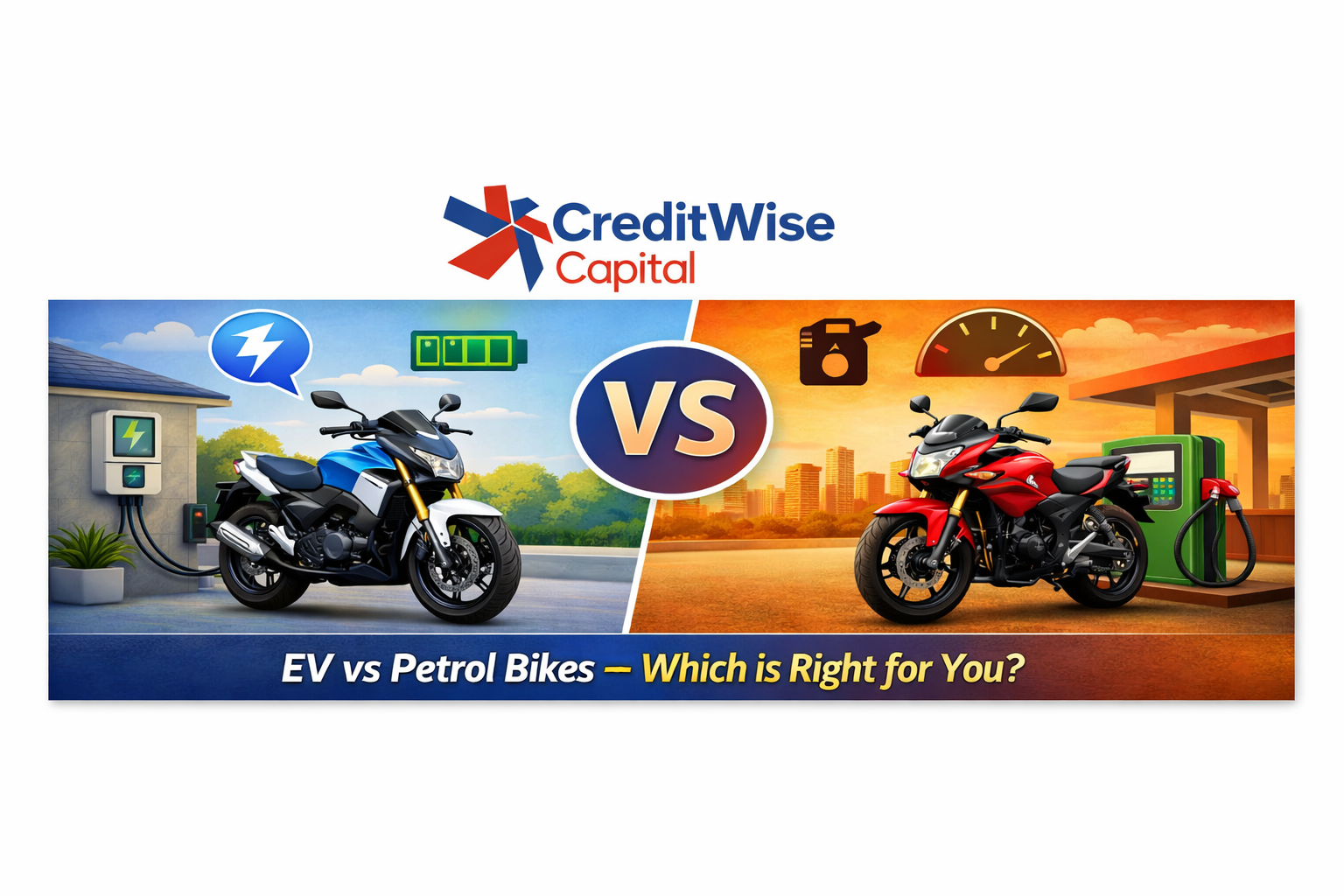
The electric bike vs petrol bike debate does not have a single universal answer, though the numbers point clearly in one direction for most urban Indian riders. Electric bikes offer dramatically lower running costs, superior city performance, zero tailpipe emissions, and a growing infrastructure network that now spans 27,000 stations and counting. Petrol bikes retain genuine advantages for highway travel, long-distance touring, and situations where charging access is limited.
If your daily commute falls within 30 – 60 km, if you have access to home or workplace charging, and if you intend to keep your bike for five years or more, the financial and practical case for an electric bike is compelling. If you regularly ride long distances on highways or in areas where charging infrastructure is still sparse, a petrol bike may better suit your current needs.
Key Takeaways
- Running cost advantage: Electric bikes cost approximately ₹0.28 to ₹0.40 per kilometre versus ₹2.10 to ₹2.50 per kilometre for petrol bikes, delivering savings of ₹70,000 to ₹1,00,000 over five years for regular commuters.
- Superior city performance: Instant torque delivery and zero gear-shifting make electric bikes the more comfortable choice for daily urban riding.
- Infrastructure growth: India now has over 27,000 public EV charging stations, a dramatic increase that has significantly reduced range anxiety for urban riders.
- Government support: The PM E-DRIVE scheme and state-level subsidies continue to reduce the effective purchase price of electric two-wheelers in 2026, subject to fund availability.
- Choose based on usage: Electric bikes excel for daily commutes under 100 km; petrol bikes remain better suited to frequent highway and long-distance riding.
| Ready to Finance Your Electric Bike? Credit Wise Capital offers quick and transparent two-wheeler loan approvals so you can make the switch to electric without delay. Click the banner on our website or apply directly online today. Apply for a Two-Wheeler Loan at Credit Wise Capital |
Frequently Asked Questions
Q1. How much does it cost to maintain an electric bike compared to a petrol bike annually?
Electric bikes require ₹1,500 to ₹2,500 per year for basic maintenance covering tyres, brakes, and routine inspections. Petrol bikes demand ₹5,000 to ₹8,000 annually due to oil changes, spark plug replacements, clutch servicing, and engine tune-ups. Over five years, this translates to maintenance savings of ₹25,000 to ₹30,000 with an electric bike.
Q2. What is the running cost per kilometre for electric bikes versus petrol bikes in India in 2026?
Electric bikes cost approximately ₹0.28 to ₹0.40 per kilometre at current home charging tariffs of ₹6 to ₹9 per unit. Petrol bikes cost ₹2.10 to ₹2.50 per kilometre at prevailing fuel prices, which range from ₹94.77 per litre in Delhi to ₹103.54 in Mumbai as of May 2026.
Q3. What are the main disadvantages of electric bikes?
Electric bikes have a shorter real-world range of 90 to 150 km compared to 300 km or more for petrol motorcycles. Charging takes 4 to 6 hours for a full charge compared to 2 to 3 minutes for refuelling. Battery replacement costs ₹50,000 to ₹60,000 after six to eight years. Long-distance and highway riding remains more practical on a petrol bike.
Q4. How do electric bikes perform in city traffic compared to petrol bikes?
Electric bikes excel in city traffic owing to instant torque delivery at zero RPM and zero clutch or gear operation. Most commuter electric bikes achieve 0 to 40 kmph in 3 to 5.2 seconds, faster than comparable petrol commuters at 4 to 6 seconds. The smoother riding experience reduces fatigue during stop-and-go commutes.
Q5. What government subsidies are available for electric bikes in India in 2026?
The PM E-DRIVE scheme, active from October 1, 2024, is the primary central government incentive for electric two-wheeler buyers. It followed EMPS 2024, the short-term transitional scheme that ran from April to September 2024, which itself followed FAME-II when that scheme concluded in March 2024. Buyers of qualifying models receive a subsidy of ₹2,500 per kWh capped at ₹5,000 per vehicle, applied as a direct deduction from the invoice price at the dealership. The scheme runs until July 31, 2026, but is fund-limited and may close earlier if the ₹10,900 crore outlay is exhausted. Multiple state governments including Maharashtra, Gujarat, and Delhi provide additional subsidies. Buyers should confirm current availability with their dealer before purchasing.
Q6. How can I finance the purchase of an electric bike in India?
Credit Wise Capital provides two-wheeler loans with quick approval, competitive interest rates, and flexible repayment tenures designed to suit a range of financial profiles. Whether you are purchasing an entry-level electric scooter or a performance electric motorcycle, a structured loan allows you to spread the upfront cost while enjoying the immediate fuel and maintenance savings that electric mobility delivers. You can apply directly through our website or by clicking the Credit Wise Capital banner featured in this article.
Disclaimer
The information on this page is intended for general informational purposes only. Vehicle prices, government subsidy details, fuel costs, and scheme eligibility criteria are subject to change and may vary based on location, dealer, and individual customer profile. Credit Wise Capital does not guarantee the accuracy or completeness of this content and recommends conducting your own due diligence before making any purchase or financial decision. Loan disbursement is subject to credit assessment and applicable terms and conditions.